Face attendance

Buyer's guide · Biometric time attendance in Zambia

Choosing biometric attendance in Zambia. Five questions that decide it.

A clocking system is only as good as the payroll it feeds. This guide compares face recognition, fingerprint, cards and paper on the things that break in Zambian workplaces — no signal, dusty hands, lent cards, retyped registers — and says plainly where Xeel face attendance fits and where it does not.

Face clock-in on an Android device: blink check and on-time confirmation

Updated 2026-11-13 · by O'Sense, Lusaka

The five questions

Ask every supplier these five.

1. Does it work with no signal?

If it needs network to clock in, it fails on the farm, the pit and the depot. Matching should run on the device and sync later, never twice.

2. Can it be done for a friend?

Cards are lent and PINs shared. A face needs a liveness check so a printed photo or a screen does not pass.

3. Whose clock is it?

A record stamped with the phone's time can be faked by changing the phone. The time should come from the server.

4. Does it pay, or just report?

An export retyped into payroll reintroduces every error. Daily and hourly pay should come from the clock, with PAYE, NAPSA and NHIMA.

5. Where is the biometric data?

Under the Data Protection Act 2021 you answer for it. Ask where templates are stored, whether they are encrypted, and who can see them.

And: where did it happen?

GPS on every clock event shows where each day was worked, without locking out a worker with a weak signal.

Compared

Four ways to take a register in Zambia.

Paper registerCards or PINsFingerprint terminalXeel face attendance
Can be done for a friendYes — anyone can signYes — cards get lentHarderNo — face and a blink, on the spot
HardwareA bookA reader and cards to replaceA terminal at every gateAn Android phone or tablet
Worn, dusty or wet hands——Can fail to readTouch-free
No signal at the siteWorksDepends on the systemDepends on the systemWorks, syncs later
Where it happenedNoThe gate it was read atThe gate it was read atGPS on every clock event
Into payrollRetyped by handUsually an exportUsually an exportDaily and hourly pay straight from the clock
Per-worker feesNoneCards per workerOften per terminal or workerNone
Works on iPhone———No — Android only
Opens doors or turnstilesNoOftenOftenNo — attendance only

Where it fits

When Xeel is the right answer, and when it is not.

It fits when people are paid by the day or the hour, when sites have weak or no signal, when hands are dusty or worn, and when you want one Android phone or tablet per site instead of a terminal at every gate. It fits farms, mines and quarries, construction, security, factories, warehouses, depots and casual labour.

It is not the answer if you need a door or turnstile to open on a match — Xeel records attendance and does not control access — or if your sites only have iPhones. It also does not deduct from monthly salaries by itself: salaried staff are paid their salary and attendance is shown to HR.

Whatever you choose, run a trial on your hardest site — the one with no signal and the longest queue at the gate — before you buy for all of them.

Questions

Biometric attendance in Zambia, answered.

What is the best biometric attendance system in Zambia?

The right one depends on the site. Ask five questions: does it work with no network, does it stop a photo or a lent card, does it record the time from a clock the worker cannot change, does it feed payroll with PAYE, NAPSA and NHIMA without retyping, and where is the biometric data kept. Xeel face attendance from O'Sense answers all five: it matches faces offline on an Android phone or tablet, uses a blink check, takes the server's time and GPS, pays daily and hourly workers from the clock, and keeps the face template encrypted on the device.

Face recognition or fingerprint: which is better for Zambian workplaces?

Fingerprint readers are a terminal at every gate and often fail on worn, cut, wet or dusty hands, which is common on farms, mines and building sites. Face recognition is touch-free and can run on an ordinary Android phone or tablet. Fingerprints are hard to share; a face with a liveness check is equally hard to fake with a photo.

Do I need internet for a biometric attendance system?

Not if it matches on the device. Many sites in Zambia have weak or no signal. Choose a system that stores each clock-in on the device and syncs later without duplicates. Xeel does this, and takes the time from the server so the phone's clock cannot be changed to fake a record.

Is biometric attendance legal in Zambia?

Biometric data is personal data under Zambia's Data Protection Act 2021 and has to be handled with care: workers should be told what is collected and why, it should be kept secure, and it should not be used for anything else. Ask any supplier where the face or fingerprint data is stored and who can see it. With Xeel the face template is encrypted on the device and never uploaded; O'Sense's privacy policy sets out the rest.

How much does a biometric attendance system cost in Zambia?

Costs come from two places: hardware and licences. Fingerprint and face terminals are bought per gate, and many systems charge per worker. Xeel runs on an Android phone or tablet the business may already own and has no per-worker licence; it is priced per month as part of Xeel, with pricing on request on WhatsApp +260 974 546 632.

Can a biometric attendance system calculate pay?

Some only export a report. Xeel pays workers on a Daily rate for the days they clocked and workers on an Hourly rate for the hours, then works out PAYE, NAPSA and NHIMA and sends payslips on WhatsApp. Monthly-salaried staff are paid their salary, with attendance shown to HR rather than deducted.

What stops workers clocking in for each other?

Cards and PINs are lent; a register is ticked by anyone. A face match with a liveness check needs the worker to be there. Xeel's blink check stops a printed photo or a picture on a screen, and the same face cannot be enrolled under two workers without a recorded override.

Does face attendance work on iPhone?

Xeel's face clock-in runs on Android phones and tablets only. The office uses the web dashboard in any browser.
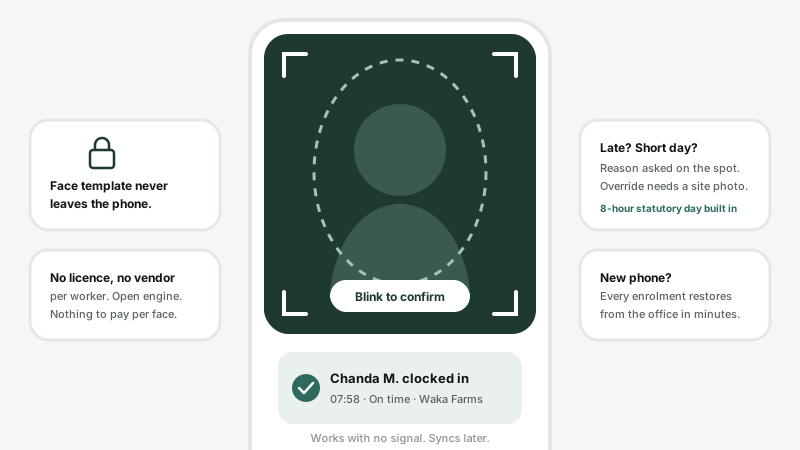
Known limits — not bugs. Face clock-in runs on Android phones and tablets, not iPhone. A clock-in outside a site boundary is recorded with its coordinates, not refused. Monthly-salaried staff are paid their salary, with attendance shown rather than deducted. Xeel records attendance; it does not open doors or turnstiles. The blink check stops a photo or a screen; it is not a claim that no attack can ever work.

By workforce

Face attendance for your kind of site.

Try it on your hardest site.

Message us on WhatsApp and we will set up a site — enrol the faces, run a week, and compare it with your register.

O'Sense is a subsidiary of HERO CONTROL SYSTEMS Ltd
Stand 34, Harrison Chongo Rd, Woodlands Extension, Lusaka, Zambia